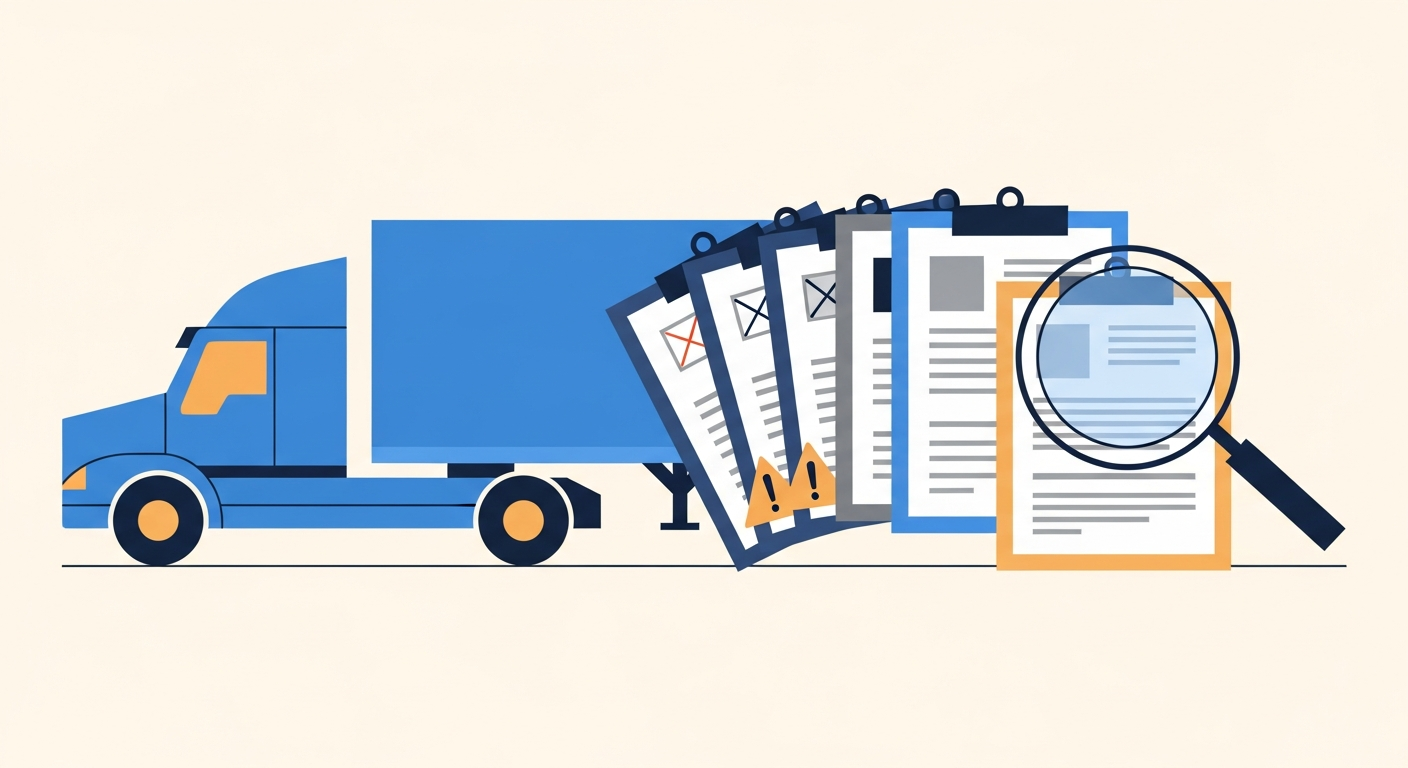
What Auditors Are Actually Looking For
When an FMCSA compliance review or roadside inspection escalates to a full audit, the investigator works through a checklist tied to the Federal Motor Carrier Safety Regulations (FMCSRs). They are not just walking around your trucks with a flashlight. They are sitting at a table asking for specific files. If you cannot produce them quickly and completely, that counts against you regardless of whether the underlying activity actually happened.
The audit covers six Behavior Analysis and Safety Improvement Categories, called BASICs: Unsafe Driving, Hours-of-Service Compliance, Driver Fitness, Controlled Substances and Alcohol, Vehicle Maintenance, and Hazardous Materials (if applicable). Each BASIC is scored separately, and a critical violation in any one of them can result in an Unsatisfactory safety rating, which can put your operating authority at risk.
The Four Document Failures That Cause Most Audit Failures
After working through what actually shows up in audit findings for small carriers, four categories of documentation failure account for the overwhelming majority of problems. None of them require a mechanical breakdown to trigger — they are purely administrative.
Vehicle Maintenance Records: What the Paper Trail Must Show
Under 49 CFR 396.3, carriers must maintain systematic inspection, repair, and maintenance records for every vehicle in their fleet. An auditor wants to see a maintenance schedule, evidence that scheduled inspections actually occurred, and documentation that any defects identified on a DVIR were either repaired or determined not to need repair before the vehicle returned to service.
The most common failure here is not that the maintenance did not happen — it is that there is no paper trail connecting the DVIR defect notation to the mechanic's repair record. If a driver writes 'left brake pulling' on a DVIR and there is no corresponding repair order showing that defect was addressed before the next trip, that is a violation even if the brake was actually fixed.
Hours of Service: Logs Are Not Enough Without Supporting Documents
If your drivers use Electronic Logging Devices, the ELD data itself is only part of what an auditor reviews. Supporting documents — bills of lading, fuel receipts, toll records, dispatch records — are used to verify that the ELD data is accurate. A log showing a driver in the sleeper berth in one state while a fuel receipt places them 200 miles away two hours later is an automatic Hours-of-Service violation.
For carriers still using paper logs for any qualifying exemption, the 8-day package of logs plus supporting documents must be retained for at least six months. Auditors will reconstruct routes using the supporting documents and compare them to the logs.
Insurance, Permits, and Operating Authority: The Pre-Audit Checklist
Auditors also verify that your insurance filings on record with FMCSA match your actual current coverage, that your UCR (Unified Carrier Registration) is current for the audit year, and that any operating authorities you are using match the cargo and routes on your bills of lading. Operating under the wrong authority type — for example, hauling household goods under a general freight authority — is a compliance violation separate from your safety rating.
State-specific permits, fuel tax registrations like IFTA, and apportioned plates under IRP are separate from the FMCSA review but can come up in state-level audits. Carriers who stay current on these tend to be the same carriers who have their federal compliance in order, because the underlying habit — tracking renewals before they expire — is the same.
How to Actually Prepare Before an Auditor Shows Up
The carriers who pass audits cleanly are not necessarily running the newest equipment or the largest fleets. They are the ones who treat document organization as a standing operating procedure, not a scramble that starts when they get an audit notice. That means every driver has a complete DQ file before their first trip, DVIRs are signed and filed the same day they are completed, drug testing records are maintained in a separate locked file, and renewal dates for every medical certificate, CDL, and insurance policy are on a calendar with advance notice.
Conduct your own internal audit at least once a year using the FMCSA's Safety Measurement System data for your DOT number as a starting point. If any of your BASICs are showing elevated percentiles, that is where an auditor is going to spend the most time. Address those areas proactively rather than waiting for the compliance review notice.
Radar's driver qualification file tracking and renewal alert system keeps your medical certificates, CDL expirations, and insurance deadlines visible in one place so you are not searching for documents when an auditor is already at your door.
Try TruckIQ Radar →This article is for general informational purposes, not legal advice. Verify specifics against current regulations or your compliance counsel.